
Two Ecosystems, One Wall
What happens to robotics technology when the world’s two largest players stop competing against each other

Let’s Start with the comparison most people make, and watch it collapse under scrutiny.
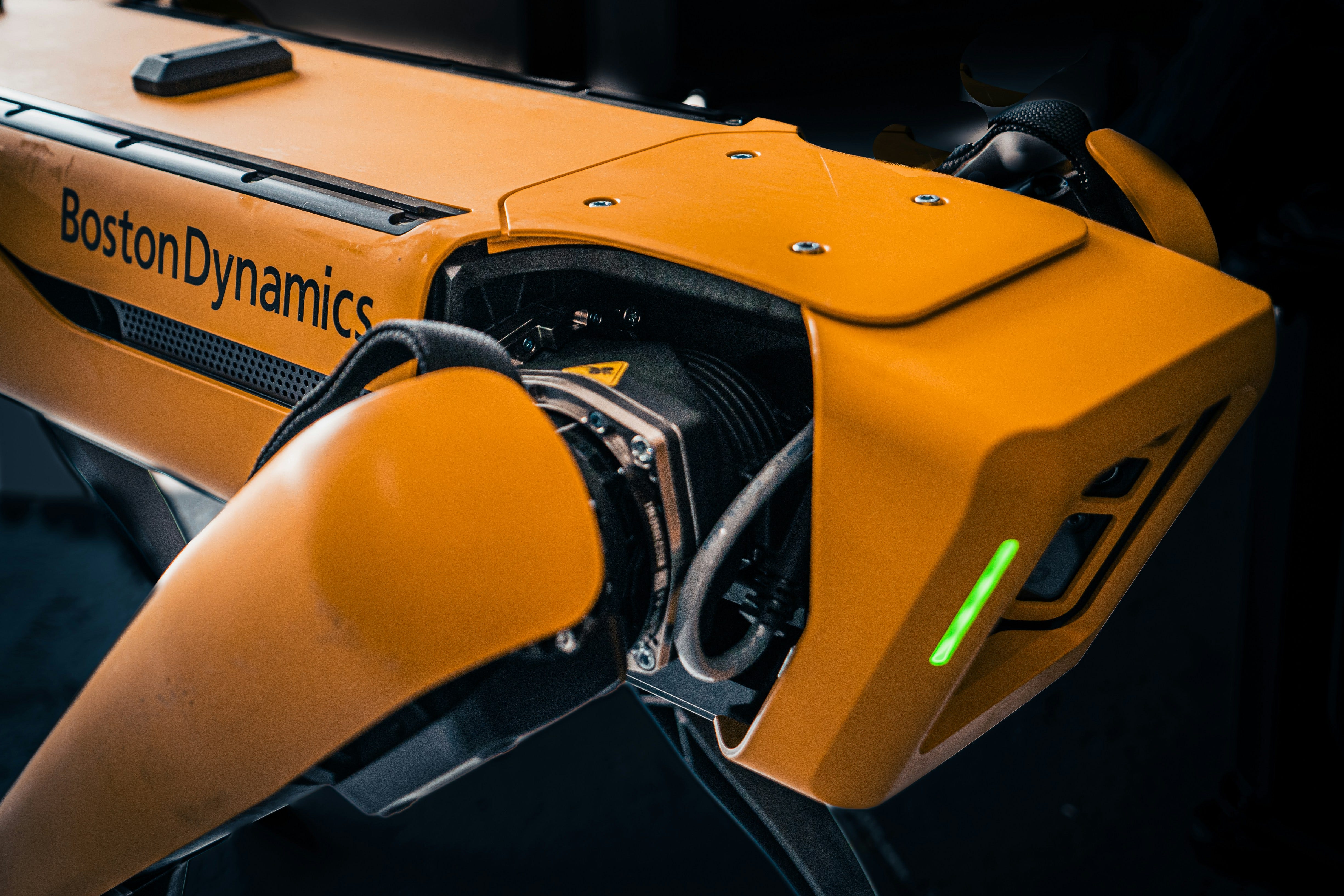
Boston Dynamics Spot: 33 kilograms, 14 kilogram payload capacity, top speed of 1.6 meters per second, IP54 weather resistance. Price: $74,500. Unitree B2: 60 kilograms, 40 kilogram payload capacity when walking, top speed of 6 meters per second, nearly four times faster, IP67 weather resistance, which means it handles full water immersion, not just splashing. Price: approximately $25,000.
These are not a toy and a professional machine. They are both industrial quadruped robots designed for the same category of work: facility inspection, perimeter security, hazardous environment monitoring, emergency response. The B2 is heavier, faster, carries nearly three times the payload, has superior weather resistance, and costs one third as much.
This is the starting point that makes what follows so interesting. Because in a normal market, that comparison would end the conversation.
What a Normal Market Would Do
When a competitor offers a comparable product at one third the price, one of two things happens. Either the premium product justifies its cost through some combination of superior reliability, better software, stronger enterprise support, or a proven track record, and commands a loyal customer base willing to pay for that, or it loses market share until pricing corrects.
Boston Dynamics Spot does have genuine advantages. It has a longer deployment history, more third party integrations, better enterprise support infrastructure, and software autonomy that is more mature. These are real things worth paying for in mission critical applications. The 3 to 1 price ratio is not entirely irrational.
But here is what the normal market logic misses entirely: a significant portion of the customer base for these robots cannot buy the cheaper product. Not because they don’t want to. Not because the B2 is inferior for their purposes. But because the law prohibits it.
The Wall, Updated
The 2025 National Defense Authorization Act, Section 1078, mandated a study on the Department of Defense’s use of unmanned ground vehicles manufactured in China and established a mechanism by which a procurement ban could automatically spring into effect without further Congressional action. The FY2026 NDAA expanded the legislative architecture further, increasing defense spending to $855.7 billion for the Department of Defense and broadening the scope of restrictions on Chinese manufactured autonomous systems.
The legislation also extended to components. Effective June 2026, DoD is prohibited from procuring items from entities on the 1260H list, a list of companies with alleged ties to the Chinese military. By June 2027, the prohibition extends further: no items in the supply chain may contain components from those entities. The net is getting wider, and it is doing so automatically, with each annual defense bill adding another layer.
This is no longer a targeted measure aimed at a handful of named companies. It is becoming a structural feature of how the US government procures technology, a standing presumption against Chinese-origin hardware in sensitive applications, with the burden of proof reversed.
Meanwhile, in December 2025, Congress encouraged the DoD to designate Unitree, the manufacturer of the B2, as a Chinese military company. In its own filings with the Shanghai Stock Exchange, Unitree executives acknowledged receiving funding from PLA connected programs.
The wall is not a diplomatic position that might soften with a change of administration. It is becoming code. It is being written into procurement law, supply chain regulations, and component-level traceability requirements. Each NDAA adds another brick.
The Mirror
China’s side of this equation is less visible to Western observers but operates on the same logic in reverse.
China’s defense procurement naturally flows to domestic manufacturers. State investment in robotics has accelerated dramatically, the government views humanoid and industrial robots as a strategic industry, not merely a commercial one. Chinese firms developing hardware for PLA programs receive preferential access to government contracts that American competitors simply cannot reach regardless of product quality.
The result is two parallel customer bases, each reserved for its domestic manufacturer. The US government’s $855 billion defense budget flows to companies that can clear American procurement requirements. China’s state budget flows to companies embedded in its own industrial ecosystem. Neither pot of money is accessible to the other side’s competitors.
This is what the price ratio actually reflects. It is not purely a quality gap. It is a market structure gap. American manufacturers are not competing against the best product in the world for government contracts, they are competing among themselves, for a buyer that cannot go elsewhere.
The Technological Consequences
This is where the long-term implications become genuinely serious, and where I think most analysis stops too early.
The first consequence is the loss of competitive pressure as a forcing function for improvement.
In open markets, you must be better than the best competitor in the world to win. That pressure produces a specific kind of discipline: constant benchmarking, aggressive iteration, an acute sensitivity to where you are falling behind. When legislation removes the most aggressive competitor from your addressable market, that pressure relaxes. The American robotics industry now competes primarily against itself for its largest contracts. self competition is less brutal than global competition. Over time, that matters.
The second consequence is diverging technical standards, and this one is underappreciated.
When two large ecosystems develop in isolation, they do not merely produce different products, they eventually produce incompatible ones. Communication protocols. Software interfaces. Sensor specifications. Navigation architectures. The longer the two ecosystems develop separately, the harder integration becomes, even in a hypothetical future where the political environment shifts. We have already seen this play out in telecommunications with Huawei. What took a decade to build in that industry is now structurally very difficult to unwind. Robotics is following the same trajectory.
The third consequence is a distortion in how we measure quality.
When a manufacturer’s primary customer cannot buy from anyone else regardless of price, quality, or performance, the normal feedback loop between product and market breaks down. Customers who cannot walk away are not the same as customers who choose to stay. The former will tell you what works within the constraints they have. The latter tell you what is genuinely best. A robotics industry that serves a captive government buyer loses access to the harshest and most honest signal the market provides.
The fourth consequence, and perhaps the most consequential over a decade, is what happens when the Chinese commercial market matures.
Right now, Chinese manufacturers can sell freely into the global commercial market while American manufacturers cannot access the Chinese market and Chinese manufacturers cannot access the American government market. If you are a Chinese robotics company with PLA funding, a cost structure shaped by domestic manufacturing economics, and access to every non aligned commercial market in the world, you are competing aggressively in the 80% of the market that is unrestricted. American manufacturers, by contrast, are competing fiercely in the government market and also in that same unrestricted commercial market, but without the structural advantage of a captive home buyer funding their fixed costs.
In other words, the American government market funds American manufacturers’ balance sheets. It also, subtly, insulates them from the most brutal form of commercial competition. That insulation may feel like strength. Over twenty years, it may prove to be fragility.
What this means for investors
I want to be precise here, because there is an easy mistake to make.
The legislative protection is real. It is durable over any reasonable investment horizon. A business that sells industrial inspection robots to the US government, and whose Chinese competitors are legally prohibited from doing the same, has a structural advantage worth paying for. That is not in dispute.
What is in dispute is whether that structural advantage is the same thing as a durable competitive moat. They are related but not identical.
A moat, properly defined, is an advantage that is self-reinforcing, one that gets harder to overcome as time passes. The legislative wall has some of that character, because each NDAA adds restrictions rather than removes them, and because supply chain compliance infrastructure becomes more embedded over time. But it also has a vulnerability that a pure product moat does not: it depends on a political environment that, while stable, is not guaranteed.
More importantly, it does not force the innovation that a pure product moat requires. A company protected by legislation does not have to be better than its Chinese competitor to win contracts. It only has to be compliant, reliable, and good enough. That is a different standard. And businesses that optimize for a different standard tend, over time, to produce a different quality of product.
The robotics companies I find most interesting in this environment are not necessarily the ones with the most government contracts. They are the ones that are winning in the unrestricted commercial market, where Chinese competitors are present, where price matters, and where the product has to earn its position on merit alone. Those companies are being sharpened by a harder benchmark.
A company that thrives only behind the wall is not the same as a company that thrives despite having a wall available.
A Note on Honesty
The robotics sector presents a recurring challenge for the kind of investing I try to practice. The structural dynamics I have described above are real and investable. But most robotics companies, even excellent ones, do not yet pass the quality filter I apply before any serious analysis: high certainty of being larger and more profitable in ten years.
The capital intensity is high. The competitive dynamics are still resolving. The technology is advancing faster than any individual company’s moat can calcify. And the geopolitical foundations of the structural advantage, while durable, are a different kind of durability than the kind produced by decades of customer switching costs or brand loyalty.
I am watching this sector carefully. I am not yet ready to put anything on the Approved List. When I am, you will know.